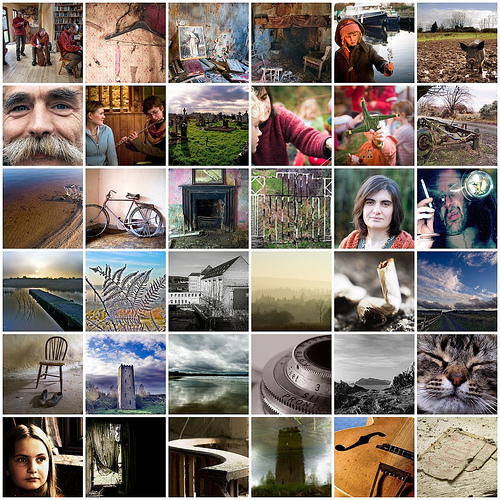
“‘Stories of art’ are produced through the curatorial process of selection, juxtaposition and interpretation of art as exhibitions and ‘permanent’ displays. These processes affect not just what the visitors see but how they are encouraged to construct meaning and understand their experiences. Additionally, catalogs and other exhibition publications enable curatorial decision-making to be disseminated far beyond visitor communities.” (Robbins, 2005).
Curating in the field of education requires these same attributes as espoused by Robbins – selection, juxtaposition, and interpretation – with different
content: that which is to be learned. The authors contend that curation of curriculum should be the story of selected content, which provides learners with opportunities to experience or view differing perspectives. The “permanent display” of educational curation allows the learner limitless opportunities to re-view and re-experience the multiple perspectives, with the ability to construct meaning each time the content is experienced. ” (Stokes, Donnell, Eaton, Sherman, in press)
Academic Curation Model
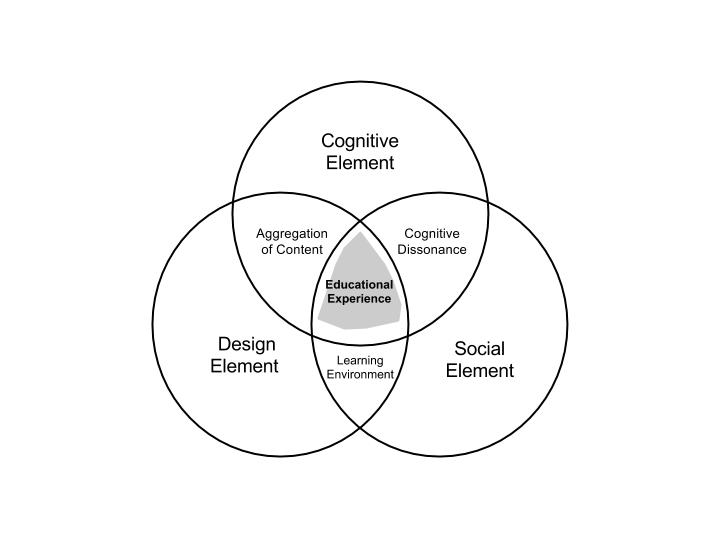 The model, as drawn above, implies equal weight between the cognitive, social, and design elements, but in practice the relative weight of these dimensions depends on what the desired learning outcomes are and the values of those participating in the instruction. In practice the model could look like any of the following since the design of each learning situation is unique and optimized based on the needs of the learning community.
Finding the right combination is an iterative process as well as an evolving one to meet the needs of the community and the learning situation. A hypotrochoid results from the interaction of two circles where one circle draws a curve as it rotates around the other. The Spirograph is a toy that demonstrates the construction of these curves.
As the inner circle rotates inside the outer circle it draws a curve that represents the interaction between them. The combination of multiple circles or elements can create some interesting patterns. So it is with academic curation. We can consider the weighted interaction of three elements to design a blended educational experience. Although the process is not linear; an explanation of the process will take that form to simplify the description of each piece.
Instructional design of learning is a craft that includes identification of experiences that are carefully woven into a tapestry of experiences. Using the Academic Curation Model as an instructional method requires seeking or taking the time to look, listen and observe the world around you. Identifying those strategic nuggets of gold that propel the learning experience into another dimension. In short, knowing what components are needed to transform existing educational structures into relevant problem based learning venues that increase student learning. Seeking, finding and linking content and instruction is only the first step within Academic Curation. Next the professor or instructor needs to bring a sense of ownership and relevance into the mix. Jarche (2010) describes the act of sensing as igniting passion within the learning context. Identifying ways to create just enough discourse to propel the learner into a place where wrestling with new perspectives causes the learner to question and challenge status quo thus moving learning from a receptive act to one of expression. The final step in Academic Curation is the structure of the engagement. As a designer of instruction, the question should be asked, “How can a challenging exchange of content be constructed to support mutual engagement between and among students?”
References
Jarche, H. (2010). Network learning: Working smarter with PMK. Retrieved July 2013 from Jarche.com/2010/10/network-learnning-working-smarter/.
Robbins, C. (2005). ‘Engaging with Curating’, International Journal of Art and Design Education, 24(2), 149-158.
 Reimagining Education