Reflections on Baruti Kafele’s Guiding Questions

I was honored to have the opportunity to participate in a learning session with Principal Baruti Kafele at the recent virtual ASCD conference Respond, Reimagine, Restart.

I experienced something I have been needing for a long time…a guide who challenged thought through reflective questioning. Although many of my former students would complain and expound on the virtues of my teaching methodology, the one thing they would always say is, ” Your class was hard because you always made us think, support our thoughts, and refine our thinking. It was not like any other class because you forced us to reflect on what we thought we knew and then stretched us by asking divergent questions.”

Principal Baruti Kafele did this for me last week. He started by asking us…

“Who are you when the students’ faces appear in your class?”

B. K. Kafele July 2020

Although this seems to be a simple question, I did not take this question lightly. This is the type of question I would have asked my former students of Education. This is the type of question every teacher should be asking him or herself in both times of certainty and uncertainty. This question transcends the fact that we are wrestling how to use space and place for teaching and learning. It leaves the plane of delivery and enters the atmosphere of connections and relationships to learning.

Who are you when your students’ faces appear in your class?

As educators we have always been more than a vessel of subject content or an expert in a particular knowledge base. We play many roles in a synchronous symphony of our craft. In her book Enhancing Professional Practice: A framework for teaching, Charlotte Danielson (2007) discusses the complexity of teaching and says that this is “a thinking person’s job” (p. 2). How often do we stop and think about who we are in relation to our students? When we are working toward meeting state standards are we also asking how we are supporting our learners’ social emotional well being?

If we reflect on my last question then we need to include the idea that even though teachers are also business managers, human relations leaders, fine arts designers…they also need to be curators of trust, restorative justice, and feelings of well being.

So the one sentence, 11 word question asked by Principal Kafele is not a simple one to answer. However, it is one that needs to be asked within the context of each day you interact with your students.

I believe we must own, that whether we like it or not, we are the glue in our students’ lives.

We are the ones who provide a safe place for making mistakes, a conduit to their family structure, a service provider of goods and services for living healthy lives, and we are their guide understanding the impact of culture on them, their community, and their future.

After watching this video, how do you answer the 3 fundamental questions?

During this time of health and civil unrest, it is now more important than ever to reassess your responses to the following questions:

1. Who we are when the students’ faces appear in our class?

2. Are you all about these children?

,3. Are you excited about your craft?

4. Are you excited about your own professional growth and development so that you can bring more to your students?

Although difficult, this is a time for innovation, recreation, and beginning of new journeys. This is a time when we, in the field of education stand up and help construct learning spaces that are available and supportive of all learners.

So, I challenge you to take some time to answer Principal Kafele’s questions about you and your practice. Write it down. Make it purposeful. Make it actionable. But most importantly share it with others so that we can start a movement that defines the answer to the question of who are you as an educator?

COVID 19 and Remote Teaching Fall of 2020

Pandemic….

We have heard about them, watched them reek havoc in the movies and followed them from afar throughout the years. But in January of 2020 something changed. Those pandemics we heard about in foreign countries or in states we do no live in; they came to camp out on our doorsteps.

As the nation watched the numbers of infections and deaths grow rapidly across the United States, our neighborhoods, our families, and maybe even ourselves we paid attention. We washed our hands, used hand sanitizer, wore masks, stayed 6 feet away from others. And then it got scary. We were told to stay home from work. Some of us lost our jobs while others worked from home. and Our children stayed home from school and quickly learned that the computer was not just for watching movies, using social media and playing games.

Video conferencing took the forefront in our lives. We worked on these platforms, played on these platforms and stayed connected to loved ones. Zoom, YouTube, Teams, and Skype were not companies that were used by organizations wanting to decrease the digital divide. These were now competencies that everyone in the US was learning to use. Young and Old. Healthy and Sick.

The access to broadband internet was now essential, not just for those who could afford the connection. Teachers, who had worked so hard to retain the status quo of teaching face to face were thrown into a chasm! Not only were teachers required to know their content, teach it to all assigned students, and ensure assessments were passes with the level deem proficient….now they had to learn new software, web based platforms and most importantly how to teach effectively on this new frontier.

The problem is that we, the educators, those of us in educational technology were so busy trying to get everyone access, that we didn’t have time to teach the pedagogy we had been pushing for years. Yes years. Educational Technologist have been trying to convince public and private schools alike to use remote learning as a tool, a source, a mode of learning that will be essential in years to come when the students are starting their careers!

But alas, no, we were told year after year, inservice after inservice, webinar after webinar- that teaching from a blended or remote approach was not the correct way to teach. We were told that the inequity of access to broadband internet would deepen the economic divide within education. We were told that our students could not learn using these platforms as well as they could sitting in a classroom.

Then, the last week in March of 2020 the school districts started closing. The safety of our students’ health required the schools to teach differently for a few weeks. A month. Through the end of the school year. Over the summer. Now, here it is June and the educational leaders are asking what should happen next. How do we get back to normal education.

We Don’t. We change our perspective. We realize that the status quo of teaching for the past 100 years will not work moving forward. So what happens now? In an Education Week article written by Gina Denny, we are introduced to “6 classroom changes teachers will make when schools reopen”. Below are a mixture of Gina and my suggestions as how teachers can move forward to prepare for the Fall no matter what the roll out of attendance looks like.

  1. All educators should be using online technology to deliver assignments, notes and other resources- as a minimum. Making this change will help redirect parents and students toward a new platform of communication with schools. The families will know where to look for information and the students will learn their way around a remote classroom.
  2. Give feedback instead of individual scores. We know that feedback is vital in forming a growth mindset. Using formative assessment to encourage students to think beyond the given assignment, ask questions, and build content knowledge that will translate into active use of information will create student buy-in, reduce monotonous grading and most importantly squelch the idea that the students are having others do their work for them.
  3. Move toward solving problems and projects that can happen in student’s daily lives. Think application, analysis and creation. Give students ways to use the content you are teaching to enhance their lives and those around them. Let’s start using the information learned in our curricula to good use!
  4. Stop teaching alone. Plan ways to incorporate other professionals into your classroom learning. Invite guest speakers to your next video chat. These individuals could be anyone from authors to recording artists to local media personalities. Ask your associates if they would be willing to be a resource to your class. Have students call these individuals or send a message in the chat box to ask questions regarding the content you teach.
  5. Re-contextualize time. Be flexible. Some of your students will thrive in this new environment. They will succeed in managing their own learning time and processing. Others, will need more support at the beginning. Collaborate with the students to find out what their schedules are at home and how the two of you can create learning that is successful. Some students will have new responsibilities now that they are at home during the day. Understanding this and working together creates a path to success. It is time to model and then guide students’ management of their workload not dictate it to them.
  6. Assist your students in discovering MESH, thank you Tim Wise. For our students to be successful now and in the future they need to own how to get information from the Media, behave ethically, and understand how sociology and history have created the world we are in today. Teaching students to read laterally, use CRAP detection, write professional emails, and use word processors, spreadsheets, databases and design tools will create learned individuals. Isn’t that what we want our schools to be about?

The Art and Science of Learning in a Digital World

“We live in a digital world.”
I heard these words on the news this morning, and thought… what does this mean for the field of education? Reflecting on changes within schools over the past 10 years, I was struck by the number of companies and organizations that have become a central part of the landscape of P-21 education.

In the past formalized learning used teachers (experts in content), text-books, in person speakers, and additional primary and secondary sources to relay content and influence student learning. We used audio visual resources to recreate experiences we were sharing with our students. Each of these assets were contained. They were purchased and used “out of the box”.

Today teaching and learning is different. It happens in various spaces that include but are not exclusive to the classroom. Resources are templated but not all inclusive in use. In other words, whether employed in K-12 or post secondary institutions, you not only need to know how to design within these digital assets but which sources of technology compliment the learning theories the institutions subscribe too.

The educational technology field is crowed. We now have choices of video creation, curriculum mapping tools, digital gaming (gamification software) and online program management companies are vying for academic funds.

Rhetorical Question: Which digital resources are important to furthering student learning and which are “nice to have” but may have no educational impact?

Enter CIOs, VPAAs, Directors of Technology, Principals and even the classroom teacher. These individuals are responsible for ensuring that purchase of digital assets further student learning. But do these employees understand the intersection of technology and pedagogy with the learner at the center of the process.

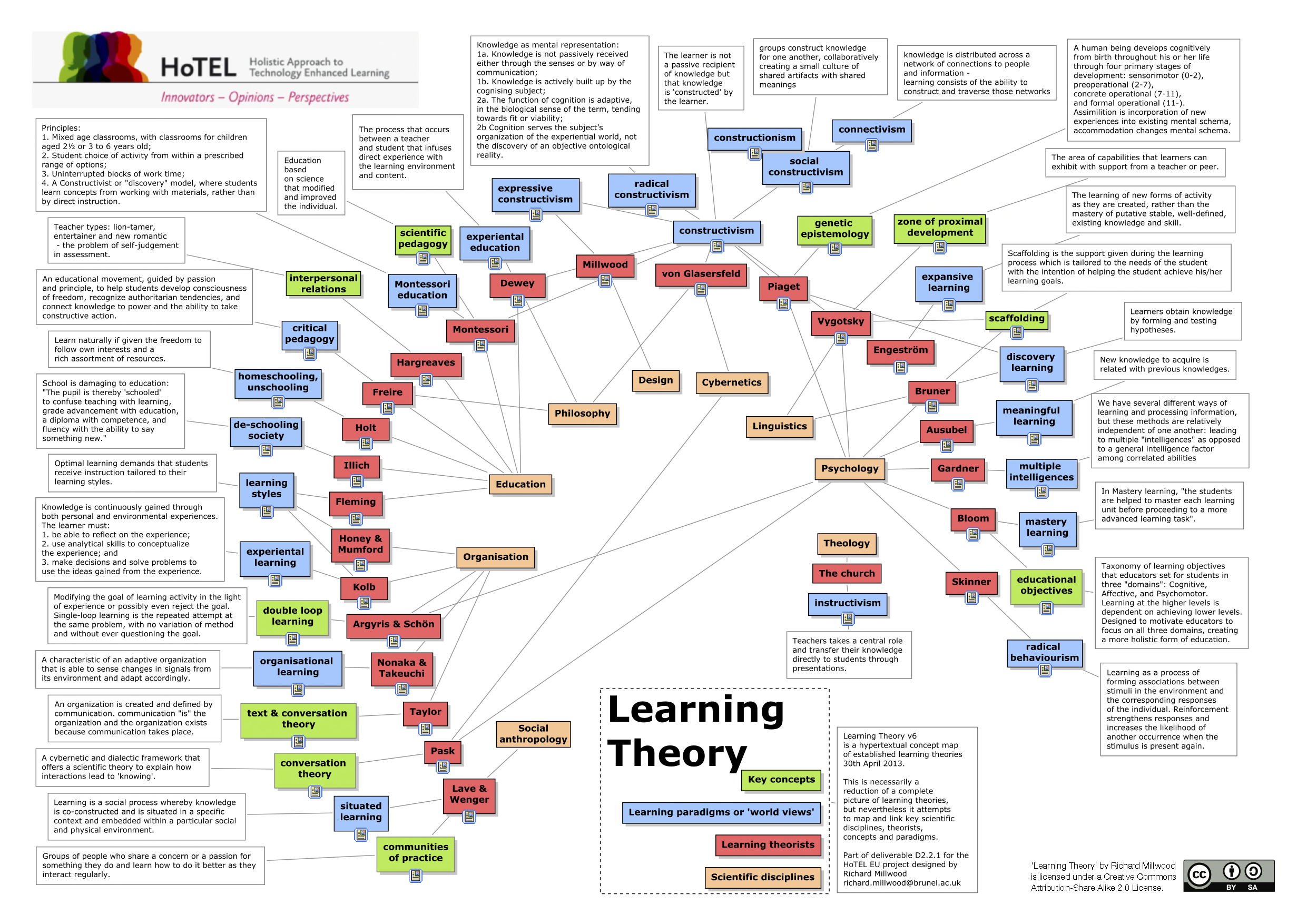
My contention is they don’t. Not as individuals. Based on a graphic Richard Millwood created, the amount of learning theorists and scientific disciplines needed to effectively identify and use technological solutions for learning is overwhelming. Take a look at the graphic below.

HoTEL
Holistic Approach to Technology Enhanced Learning


The implications are enumerable. So, how does an educational organization ensure those purchasing and implementing technological tools or systems, have the pedagogical and technological background needed to make the best decision possible? My suggestion… create an ecosystem that supports the purchasing, training and end-use of digital assets. To accomplish this a collaborative team should be constructed.

Identify five individuals who have a broad understanding of learning. Ensure that each is from a different discipline: (a) philosophy, (b) education, (c) design/training, (d) psychology, and (d) cybernetics. Then, as a team, create a statement of learning that best describes your organization’s approach to education.

Are you a social constructivist organization with a flair for double loop learning?

Maybe you are an institution who believes that interpersonal relations, critical and scientific pedagogy are the philosophical foundation of your curriculum construction.

No matter what the definition of learning theory you subscribe to, understanding the implications of choosing digital assets is the key. At least one person on your team needs to be able to translate your school’s learning theory into usage of educational technology to promote student learning. Then effectively translate the intersection of these two worlds to the rest of the educational stakeholders.

Without the understanding of how the digital world and learning theory intersect; educators and educational institutions are likely doomed to spend millions of dollars on assets that not only live unused in cyberspace, but possibly get in the way of student learning success.


Next Gen Learning

April 9, 2015 Vander Ark blogpost in Education Week.

As an individual who uses big picture and systems thinking to create plans of action, I thought it necessary to share key learnings about digital ecosystems within the field of education. In the April 2015 article written by Tom Vander Ark, he discussed the underinvestment and feeble articulation of learning platforms within institutionalized learning organizations. The contention was that schools were approximately 5 years behind in creating learning spaces that included competency-based and learner centered activities that shape future citizens to problem-solve, ideate, and test solutions.

My mind began to wonder… “Why are we so behind in our thinking?” ,,, “How is it that a field dedicated to life long learning, inquiry, and knowledge sharing continue to operate in a reactive versus proactive state?”

My contention is that we are so busy making sure that our content is delivered through reliable and valid outlets that we miss transformational opportunities to scale our field’s actions to build the human capital needed in a world with access to rapid information exchange.

Please do not misinterpret the statement above. Validity and reliability within knowledge sharing is vital to societal growth in skills and capacities. But maybe, the field of formal education should take a page from the book of inventors and explorers. Maybe, we need to put some of our resources into design thinking techniques to extend our capacity beyond what we know to be true and dabble in uncharted waters.

So let us journey into dissecting current ecosystem of learning. A plan of action needs to include: collection of the current state of learning institutions’  use of digital tools to provide content and socialization, iterative discussions of why we function within this paradigm, creation of a system that builds on the current ecosystem, and finally ideation of future functioning.

To provide background information about digital ecosystems I have included information from Vander Ark’s blog post, recently reprinted in Education Week’s April 15th issue, to gain more information regarding the idea of a digital ecosystem. Here is what he said,

[There] are 12 components of next-gen learning and 12 development vectors, groups of organizations on a similar path to next-gen learning, and 12 suggestions for philanthropies that want to accelerate progress.

Digital Components

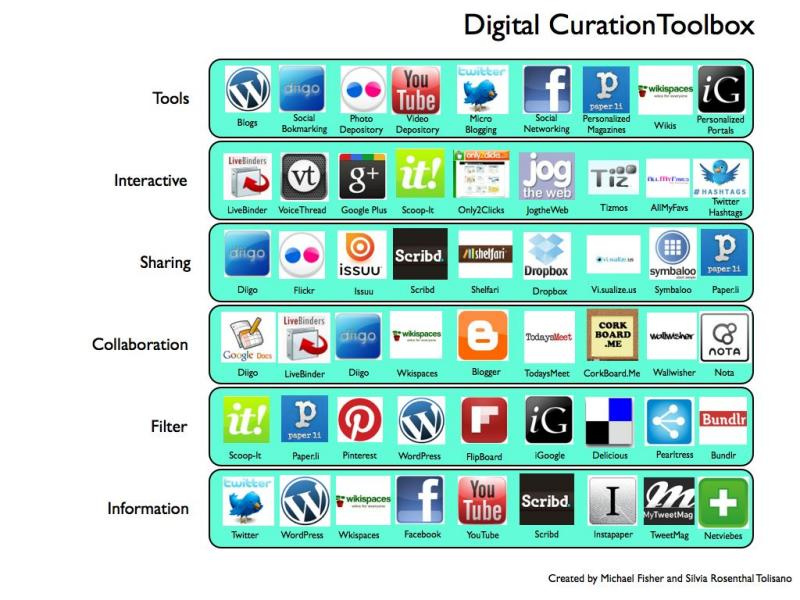
Digital Curation Tool Box Image

When defining components Vander Ark described them as digital platforms. Digital components such as  learning, relationship, content, integration, and assessment tools tend to be found in many schools today. What is not seen is the use of these tools to integrate the entire learning experience. If advising, cross-collaboration, data bases for knowledge sharing, integration of data across courses or grade levels, or a comprehensive personalized area that allows for artifact usage were intentionally applied within the student experience these components would enable learners to shine brightly.

Development Vectors

Forces that bring about change within the system can be referred to as development vectors. Re-envisionning social interaction, time, space, place and engagement might create pathways to non-identified learning options. Our field appears to be dabbling in this idea. I believe that many learning and training systems are just beginning to redefine how the concepts listed above have an effect on learning. The challenge is to change our lens as we envision the future. If we take this risk, a door will open to new ways of thinking about competency, data, dashboards and universal design of learning.

Alignment of Services

These groups of constellations create important and beautiful images when discussed in isolation. Each are important and have functions within learning that are all inclusive. However, the amazing power of alignment of student, faculty, institution and administration services is at our fingertips. With intentional integration through strategic planning; day to day operations could become more effective and powerful.

Questions to ponder:

  • What future benefits are derived, within the ecosystem of learning organizations,  through choosing use digital tools to drive systems thinking and learning?
  • What components are important and why?
  • Can they be used to scale effective societal growth?
  • Does mapping future structures, overarching themes, and concepts toward intentional use of these tools catapult institutionalized learning from yesterdays’ intended purpose?
  • Are learning organizations creating a planned digital ecosystem that includes vectors, components and constellations?
  • Is there a blueprint within each institution that shows the relationships between these components and how they will enhance society overall?

References:

Vander Ark, T. (2015). How learning will work in the near future: 12 features of nex-gen platforms. Education Week Blog Post April 15, 2015. Retrieved April 15, 2015 from http://blogs.edweek.org/edweek/on_innovation/2015/01/how_learning_will_work_in_the_near_future_12_features_of_next_gen_platforms.html

The Scholarship of Teaching and Learning

Reposted from Avila University CTL website

Originally posted August 2014

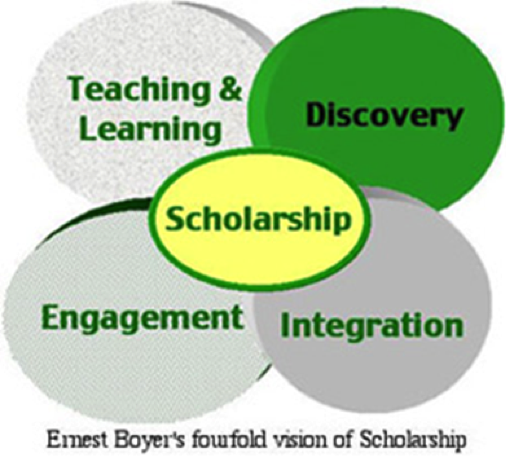
Image of SoTL
Image of SoTL


“Boyer began the process of examining the relationship between research and teaching and advocated for the scholarly consideration of how teaching methods relate to the subject content being learned by students” (McCrea & Ginsberg, 2009)

The origin of  Scholarship of Teaching and Learning (SoTL) dates back to 1990, when Dr. Ernest Boyer was the president of the Carnegie Foundation of the Advancement of Teaching and Learning. He worked to create a framework that would enhance teaching and learning capabilities of faculty within institutions of higher education.

Boyer proposed that faculty should spend the same amount of time in active scholarship within the areas of discovery learning, content integration and application of learning as they do within their chosen field of study. The intent was to promote an instructional venue that empowered student learning based on research that informed faculty instructional decision making.

In 1997, Lee Schulman became the president of the Carnegie Foundation of the Advancement of Teaching and Learning. He furthered Boyer’s vision through distinguishing scholarship of content knowledge and effective communication of content.

Today SoTL is becoming a guiding practice within higher education institutions. According to Hutchings, Huber, and Ciccone (2011, p. xix), “the scholarship of teaching and learning encompasses a broad set of practices that engage teachers in looking closely and critically at student learning in order to improve their own courses and programs, and to share insights with other educators who can evaluate and build on their efforts.” Conceptually, the above-mentioned practices are “best understood as an approach that marries scholarly inquiry to any of the intellectual tasks that comprise the work of teaching – designing a course, facilitating classroom activities, trying out new pedagogical ideas, advising, writing student learning outcomes, evaluating programs” (Schulman, 1998). When activities like these are undertaken with serious questions about student learning in mind, one enters the territory of the scholarship of teaching and learning.”

A variety of methodologies are used when actively pursuing the Scholarship of Teaching and Learning. this includes but is not limited to the “reflection and analysis, interviews and focus groups, questionnaires and surveys, content analysis of text, secondary analysis of existing data, quasi-experiments (e.g. comparison of two sections of the same course), observational research, and case studies” (Wikipedia, Scholarship of Teaching and Learning).

References:

Boyer, E. (1990). Scholarship reconsidered: Priorities of the professoriate. Princeton, NJ: Carnegie Foundation for the Advancement of Teaching..

Hutchings, P., Huber, M., & Ciccone, A. (2011). The Scholarship of Teaching and Learning Reconsidered  San Francisco: Jossey-Bass.

McCrea, E., and Ginsberg, S. (2009, April). What is the Scholarship of Teaching and Learning (SoTL)? What resources has ASHA Developed for Faculty in Communication Disorders. Access Academics and Research. Retrieved March 4, 2015 from http://www.asha.org/academic/questions/SOTL/

Wikipedia Scholarship of Teaching and Learning retrieved March 4, 2015 from http://en.wikipedia.org/wiki/Scholarship_of_Teaching_and_Learning

Team-Based Learning

Team Based Learning an Overview

Team based learning is an instructional design methodology that creates a venue for students to learn as an individual at the lowest level of Bloom’s Taxonomy and scaffolds the learners into a creation based learning experience through collaborative efforts. TBL Graphic

The Description of the Artifact

This artifact is taken from a course on Instructional Design that was taught in the fall of 2013. The purpose of the course structure was to guide the learners from acquisition of content regarding design and development within instructional design to creation and evaluation of current practices within his or her organization. Each unit was constructed to include individual readings and quizzes, team based assessments, problems, and participation in team simulations.

Artifact for TBL

IBSTPI Competencies Met

Planning and Analysis- 8

Select and Use analysis techniques for determining instructional content.

Review of scores from individual quizzes allowed for construction of instructional content that would best meet participant learning needs. As seen in the screenshot above, the participants were provided readings to create a knowledge base regarding planning and analysis within instructional design. Each person was then required to complete an individual quiz based on learnings. A group review of content learned based on each question provided me with an opportunity to review the construction of the questions or modify learning content based on the need for additional information. This is why there is a section for additional resources. The intent was to used participant knowledge to drive selection of additional needed content to support the highest level of learning possible.

Design and Development- 11

Organize instructional programs and or products to be designed, developed and evaluated:

  • Determine overall scope of program
  • Identify sequence of instructional goals
  • Specify and sequence anticipated learning

The artifact shows a sequencing of learning that moves from individual recall to interactive team based learning to support exchange of ideas to create a synthesis of learned content. Each unit within the course was designed in the same scope and sequence to provide a usable framework that supports repetition and consistency of learning methodology.

Reflection

The structure of the team based learning gives participants the ability to own the learning sequence of content thus enabling individual movement through each unit with confidence. The appeal process after each individual quiz is beneficial for both the students and the instructors. This process created clarification of content, reassessment of thinking when responding to questions, and opportunities for learners to provide additional or outside resources to promote higher level learning and ownership of response.

A concern with this methodology that should be considered is the ownership of individuals effort within the team process. Although learners are adults, the ownership of equal participation within team problems and simulations was not always evident. Students on some teams share frustration with team members who did not participate fully within the process.

Using team charters, facilitating team conflict, and learning about the use of collaboration on projects in the world of work are all areas that should be intentionally taught to students to enhance their participation with these assignments.

I continue to use this methodology due to the scaffold learning and require ownership of learning by the student. The structure creates a venue that supports higher level thinking and problem solving instead of a regurgitation of content with little or no connections.