Team-Based Learning

Team Based Learning an Overview

Team based learning is an instructional design methodology that creates a venue for students to learn as an individual at the lowest level of Bloom’s Taxonomy and scaffolds the learners into a creation based learning experience through collaborative efforts. TBL Graphic

The Description of the Artifact

This artifact is taken from a course on Instructional Design that was taught in the fall of 2013. The purpose of the course structure was to guide the learners from acquisition of content regarding design and development within instructional design to creation and evaluation of current practices within his or her organization. Each unit was constructed to include individual readings and quizzes, team based assessments, problems, and participation in team simulations.

Artifact for TBL

IBSTPI Competencies Met

Planning and Analysis- 8

Select and Use analysis techniques for determining instructional content.

Review of scores from individual quizzes allowed for construction of instructional content that would best meet participant learning needs. As seen in the screenshot above, the participants were provided readings to create a knowledge base regarding planning and analysis within instructional design. Each person was then required to complete an individual quiz based on learnings. A group review of content learned based on each question provided me with an opportunity to review the construction of the questions or modify learning content based on the need for additional information. This is why there is a section for additional resources. The intent was to used participant knowledge to drive selection of additional needed content to support the highest level of learning possible.

Design and Development- 11

Organize instructional programs and or products to be designed, developed and evaluated:

  • Determine overall scope of program
  • Identify sequence of instructional goals
  • Specify and sequence anticipated learning

The artifact shows a sequencing of learning that moves from individual recall to interactive team based learning to support exchange of ideas to create a synthesis of learned content. Each unit within the course was designed in the same scope and sequence to provide a usable framework that supports repetition and consistency of learning methodology.

Reflection

The structure of the team based learning gives participants the ability to own the learning sequence of content thus enabling individual movement through each unit with confidence. The appeal process after each individual quiz is beneficial for both the students and the instructors. This process created clarification of content, reassessment of thinking when responding to questions, and opportunities for learners to provide additional or outside resources to promote higher level learning and ownership of response.

A concern with this methodology that should be considered is the ownership of individuals effort within the team process. Although learners are adults, the ownership of equal participation within team problems and simulations was not always evident. Students on some teams share frustration with team members who did not participate fully within the process.

Using team charters, facilitating team conflict, and learning about the use of collaboration on projects in the world of work are all areas that should be intentionally taught to students to enhance their participation with these assignments.

I continue to use this methodology due to the scaffold learning and require ownership of learning by the student. The structure creates a venue that supports higher level thinking and problem solving instead of a regurgitation of content with little or no connections.

ID 611 Experiential Essay

In 2012 a colleague and I set out to create an interdisciplinary graduate certificate that would support business, human resources, organizational development, training, and higher educational design within learning. Our goal was to create a 5 course certificate that would enable participants to experience adult learning theory within the construct of learning design.

The first course we designed, Introduction to Instructional Design, is described below.

LEARNING METHODOLOGY

The Instructional Design and Technology (IDT) Course is an accelerated learning, time intensive course designed for adults. The design of the course recognizes that adults learn most effectively and most rapidly through a process of self-discovery and self-learning. The design of the course further recognizes that each adult brings life, work and religious experiences to the course that can be a learning resource to the other students in the class.

Shared-learning is to occur in the classroom, where each participant learns from the life and professional experiences of others. Self-learning is to occur before class so that each participant can contribute in a meaningful way to group discussions and be an effective resource in shared-learning.

Each adult learner in the course must be a participant, with secondary responsibility for the learning of others through the sharing of his or her own thinking and work experience. The principal responsibility of the facilitators is to facilitate the learning process, not to teach the technical content of the course. The facilitators are technical experts in the field and will answer questions beyond the competence of the participants, but the primary responsibility for learning belongs to the student. Ordinarily, the facilitators will not lecture for extended periods of time.

At first, a student may feel that he/she doesn’t have much experience that can be shared. As the course progresses, most students are delighted to discover that they have more relevant experiences than they first thought.

SUGGESTED GRADING REQUIREMENTS

The Avila Graduate Certificate in IDT uses a competency-based evaluation process. The grading criteria is explained below in the next section. Generally students demonstrating an accomplished level of competency in most areas will receive the highest grade. Showing solid competency in most areas will result in the next level. Competencies are assessed through ePortfolios, publications within blogs and wikis, and through observations in various team and individual activities.

At the heart of this process is the ePortfolio which each student will maintain throughout the certificate program. It is based generally on these competency areas for instructional designers (ibstpi (c) www.ibstpi.org and 2012 ibstpi ID Competencies):

  • Professional Foundations
  • Planning and Analysis
  • Design and Development
  • Evaluation and Implementation
  • Management

The class will create and maintain a knowledge base using a wiki site. Students will contribute to the site and collaborate on each other’s work. In addition each student will publish one professional blog article based on work conducted in the team project as described below. The assessment of professional foundations will come from the ePortfolio, wiki, and blog for competencies related to effective communication, application of research and theory, and managing one’s self-learning.

During this course on IDT trends students will collaborate in teams to analyze a training program based on learning theory, instructional design, and technology used in the program. The report will form some opinions, positions, or hypotheses that students may use in an applied setting during subsequent courses in the program.

Students will collaborate in this analysis using a Google shared document. It’s revision history will allow the instructor to view the contribution of each student in the team and to evaluate the meaningful contributions of the student to the team effort.

The analysis will also form the basis for two additional graded assignments as follows:

  • Each students will publish a blog article using their preferred blog tool of choice (a published article in the organizational website of the student’s employment, a personal blog, a Canvas course blog, or as a guest blogger in another blog site. The topic may be directly or indirectly related to the analysis.
  • Student teams will give a presentation to the class on the results of their analyses. Teams will use a modern presentation tool of choice to curate and present (Storify, Prezi, Google presentation, etc.).

Background Information

Introduction to Prior Learning:Introduction Page Icon

Working at Avila University has brought a variety of exciting and challenging experiences. As an employee who is both faculty and administrative, I am continuously reviewing the purpose behind new initiatives in order to bring value and growth into academic experiences.

Participation in book studies, webinars, national conferences, and course development have provided me a plethora of experiences that have guided, revised, helped refine my practice as an educator. The content in the course Instructional Design 611 appears to dovetail nicely with my learning over the past 6 years.

competencyimageThe competencies and outcomes in ID 611 are aligned in four instructional parts.

Part 1: Learning theories (This link supports all three items below)

  1. Use learning theories to describe how people learn.
  2. Describe the impact of technology on learning theory.

  3. Apply aggregation technology in evaluating and describing principles and theories.

Part 2: Instructional design models (Individual links provided below)

  1. Examine ID competencies and create an ePortfolio.

  2. Compare Andragogy and Pedagogy as it relates to instructional design models.

  3. Create and maintain a Professional Learning Network (PLN) through a wiki site to increase IDT knowledge.

  4. Analyze an existing course or case study.

Part 3: New directions in instructional design.

The link below is an artifact for each of the objectives and competencies below.

  1. Explain the difference between learning theory and instructional theory.

  2. Illustrate how an existing instructional design model is or is not an instructional design theory.

  3. Appraise a curation model as an instructional theory. (This link supports the Storify artifact link above.)

Part 4: Theoretical framework behind each intersecting dimension of an academic curation model. (This link will support the objectives and competencies below)

  1. Summarize the intersecting dimensions of an academic curation model.

  2. Use prior course learning to summarize a course or case study analysis.

Academic Curation


“‘Stories of art’ are produced through the curatorial process of selection, juxtaposition and interpretation of art as exhibitions and ‘permanent’ displays. These processes affect not just what the visitors see but how they are encouraged to construct meaning and understand their experiences. Additionally, catalogs and other exhibition publications enable curatorial decision-making to be disseminated far beyond visitor communities.” (Robbins, 2005).

Curating in the field of education requires these same attributes as espoused by Robbins – selection, juxtaposition, and interpretation – with different
content: that which is to be learned. The authors contend that curation of curriculum should be the story of selected content, which provides learners with opportunities to experience or view differing perspectives. The “permanent display” of educational curation allows the learner limitless opportunities to re-view and re-experience the multiple perspectives, with the ability to construct meaning each time the content is experienced. ” (Stokes, Donnell, Eaton, Sherman, in press)

Academic Curation Model

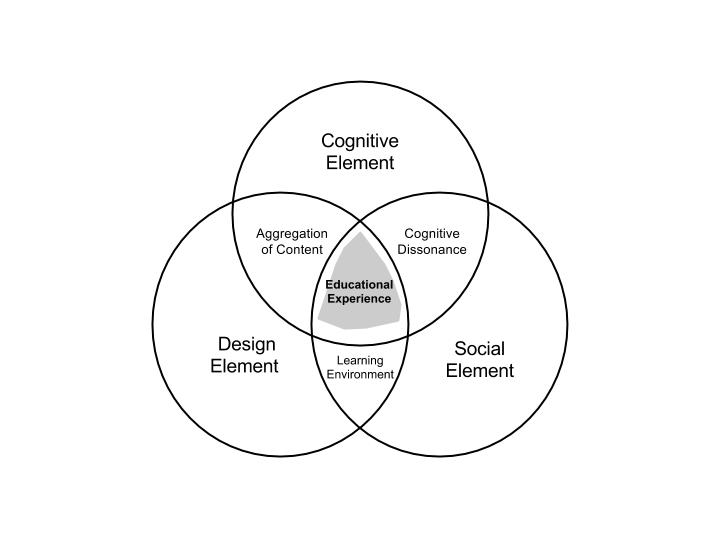
Chapter 2_ Creating an educational definition of curation-1 copyThe model, as drawn above, implies equal weight between the cognitive, social, and design elements, but in practice the relative weight of these dimensions depends on what the desired learning outcomes are and the values of those participating in the instruction. In practice the model could look like any of the following since the design of each learning situation is unique and optimized based on the needs of the learning community.

Finding the right combination is an iterative process as well as an evolving one to meet the needs of the community and the learning situation. A hypotrochoid results from the interaction of two circles where one circle draws a curve as it rotates around the other. The Spirograph is a toy that demonstrates the construction of these curves.
As the inner circle rotates inside the outer circle it draws a curve that represents the interaction between them. The combination of multiple circles or elements can create some interesting patterns. So it is with academic curation. We can consider the weighted interaction of three elements to design a blended educational experience. Although the process is not linear; an explanation of the process will take that form to simplify the description of each piece.

Instructional design of learning is a craft that includes identification of experiences that are carefully woven into a tapestry of experiences. Using the Academic Curation Model as an instructional method requires seeking or taking the time to look, listen and observe the world around you. Identifying those strategic nuggets of gold that propel the learning experience into another dimension. In short, knowing what components are needed to transform existing educational structures into relevant problem based learning venues that increase student learning. Seeking, finding and linking content and instruction is only the first step within Academic Curation. Next the professor or instructor needs to bring a sense of ownership and relevance into the mix. Jarche (2010) describes the act of sensing as igniting passion within the learning context. Identifying ways to create just enough discourse to propel the learner into a place where wrestling with new perspectives causes the learner to question and challenge status quo thus moving learning from a receptive act to one of expression. The final step in Academic Curation is the structure of the engagement. As a designer of instruction, the question should be asked, “How can a challenging exchange of content be constructed to support mutual engagement between and among students?”

References

Jarche, H. (2010). Network learning: Working smarter with PMK. Retrieved July 2013 from Jarche.com/2010/10/network-learnning-working-smarter/.

Robbins, C. (2005). ‘Engaging with Curating’, International Journal of Art and Design Education, 24(2), 149-158.