1 Introduction
Since 2006, the MacArthur Foundation has been conducting research to guide the transformation of public education to prepare youth for the “for the complex and connected social, economic, and political demands of the 21st century” (MacArthur Foundation, 2010, p. 1). Re-envisioning learning and schooling to promote prosperity in America regarding innovation and economic mobility is a monumental task and one that takes a well oil learning organization. How do schools step away from the idea of reform and move toward re-envisioning?
1.1 Required Structures
Guiding Vision
The guiding vision is to create transformational learning spaces that help move schooling from the industrialized structure to one of flexibility, mobility, and collaboration. The creation of a learning incubator that produces people who have competencies to scale growth in local and global society should inform the redesign of our nation’s schools. This venue requires a team of individuals who understand how learning works (cognitive, meta-cognitive, and experiential), ways to design various learning spaces that allow for engagement of diverse learners, environmental factors to support problem based experiences, and driven by an innovative paradigm based on data and action research.
Organizational Change Framework
Every day people experience change. At times, perception of resistance to change influences organizations to modify their systems or intentionally maintain the status quo. Interestingly, people are confronted with and even volunteer to change continuously throughout life. If life is filled with modifications and variation, why do organizations have difficulty implementing change? Heath and Heath (2010) describe the two components of change that tend to fight against each other: analytical reasoning and emotional reasoning. Most people tend to make changes based on emotional reasoning that currently fits into the automaticity of everyday life. Thus, fear of a perceived problem causes the individual to analyze what has worked before, weigh the emotional effect, and create a solution with the least amount of discomfort to daily living.
Barriers to organizational change occur due to (a) lack of clarity, (b) a feeling of being overwhelmed, and (c) a perception of lack of control (Heath & Heath, 2010). The authors suggested helping individuals identify bright spots within a proposed change initiative, script the proposed actions, and clearly point to the proposed destination. To achieve these steps there needs to be intentional collaboration between the individual, organizational, and societal levels.
Curricular Design
At present there are three movements that are effecting curricular design, (a) design thinking, (b) instructional design technology, and (c) authentic learning. Each is playing a part in K-12 and higher education redesign efforts. The bridge that connects these methodologies is the vehicle needed to move away from the cyclical iteration of institutionalized learning and into one that spirals to support scaled learning. With the curriculum design of collective learning, the individual is provided a variety of tools to construct meaning, apply skills, negotiate social constructs, and interpret to identify the changing world of best practice.
Cross Generational Learning Teams
The National Commission on Teaching and America’s Future (Carroll & Foster, 2008) created a report that identifies trends and demographics in our education workforce. Areas reviewed were: (a) re-envisioning retirement, (b) the teaching quality gap, and (c) leveraging community resources. Carroll (2009) suggested creation of cross generational teams to infuse the expertise of university professors, community leaders, graduate research assistants, educators, and student peers to build skills and content mastery associated with 21st century curriculum.
Team Description
- Re-imagining Public School Educators: Instead of being the solo repository of content, pedagogy, and assessment; the role of the educator would morph into that of a learning team manager. The responsibilities could include: identification and creation of community partnerships with content experts, subject matter expert in delivery of learning in the digital age, and instructional designer of problem-based learning.
- Building a Repository of Subject Matter Experts: Leveraging community partnerships to support K-12 schools, extends the learning environment from traditional classrooms to real-world locations to solve existing societal problems. The focus is to create a plan that effectively employs the talents of retiring Baby Boomers as experts and mentors. The vision is to partner “encore careerists [to] work with Millennial Age teachers and Digital Age student to together deliver the knowledge, skills, and tools to help all student develop the competencies they need to succeed in a complex world” (Carroll & Foster, 2008, p. 9).
2 Moving Theory into Action
2.1 Connected Learning
Overview
Schools currently organize teams to create alignment of instructional methods and assessments to enhance student learning. The increased use of social media, has allowed for educators to move from localized to global collaboration. Connected learning, according to the MacArthur Foundation (2013) “draws on successful approaches of the past and is based on evidence of what worked best in contemporary contexts. It uses the tools of the digital age to connect academics to a learner’s interests and the learner to inspiring peers and mentors…” (p. 2)
Actionable Plan
Connected learning can happen in both synchronous and asynchronous platforms. Google Drive allows access to building, sharing, and publishing information in spreadsheets, documents, presentations, and forms in real time. Use of Web 1.0 and 2.0 tools is not new to classroom learning tools. However few learning spaces have lessons and experiences designed to take place beyond the physical classroom. Employing the “human and tangible rules” of design thinking with social media intentionally creates opportunities for students to solve problems and innovate with individuals who are expert in various areas of study. Building a working group of students from various countries, ages, and classes in conjunction with field experts from various businesses would create a cross-generational connected learning experience.
2.2 Instructional Design Implications
Academic Curation Model
Three university professors to help conceived the model instructors/teachers/trainers effectively design learning experiences through intentional use of information and digital technology. The basic components are use of cognitive, social, and design presence.
- Social Presence generates a fusion of culture context, community, and past experiences to enhance learning. This discovery or inquiry methodology helps the curriculum designer identify current practices within the content area. Through use of selected tools the designer guide an interactive learner experience.
- Cognitive Presence brings the designer’s sense or prior knowledge of learning into the plan. Seeking, sensing, and sharing support learning research in the fields of neurology, pedagogy, and andragogy. The designer creates opportunities for learners to define, discover, ideate, experiment, and refine skills and concepts.
- Design Presence is the process by which learners ideate through collaboration and iteration. Authentic and problem-based structures provide students with spaces to interact with peers to make innovative changes in current practice.
Evolution of the Web
Understanding the evolution of the Web and the role of digital technology in society is crucial to the development of future learning programs. Discovery and creation in digital platforms are happening at a faster rate than ever before. Big Think describes the movement from 1.0: search capabilities to 2.0 social connections as slow compared to developments on the horizon for 3.0 and 4.0. The next generation of web capabilities has already been designed and starting to be implemented. Web 3.0 offers navigation within a 3 dimensional space. Even though gamers have been enjoying this explosion of technological design for several years now, the mainstream is just beginning to experience it. Users now have the capability to virtually navigate spaces and places. Transportation into and movement throughout a blood cell or plant root is now possible opening doors to experiential learning. A virtual walk through a showroom or new home allows for in depth understanding of products or structures. The 4th iteration of the web is already being created. This version of the web takes us into access to a personal intelligence agent. This technology creates a virtual personal assistant who provides information and support services that are individualized. The focuses of re-envisioning institutional learning must contain the understanding of the effect digital media and the web have on daily function.
Expanding the Definition of Space and Place in Learning
Rethinking space and place of learning will involve flexible instructional designs that support collaboration, individual experimentation, and transfer of content into authentic experiences within the desired field of study. No longer will a physical location be the only place to access learning. On ground and distance learning platforms will not sustain authentic experiences. Consideration of the four design thinking rules identified by Plattner, Meinel and Leifer” (2011) support the designer in either scaling or scaffolding learning and mentor metacognitive moments during each experience. The four rules are:
“The human rule – all design activity is ultimately social in nature.
The ambiguity rule – design thinkers must preserve ambiguity.
The re-design rule – all design is re-design.
The tangibility rule – making ideas tangible always facilitates communication”
In addition to instructional design for learning, building flexible instructional spaces where simulations, experimentation, discourse, and discovery can take place are also essential. The Learning Spaces Collaboratory (www.pkallsc.org ) suggest the following conditions to enhance learning spaces:
- “Spaces for collaborative, social learning, where active learning groups, problem-based learning teams, formal and informal group work takes place,
- Spaces for acquiring and enhancing depth of understanding, gaining facility with the practices and tools of the field, opening up new ways of questioning and exploring,
- Spaces for communicating, critiquing, sharing, and celebrating what is being learned, what students are becoming, and
- Spaces for renewal and reflection as individual learner and within small groups of learners 24/7:easy intuitive access, aesthetically pleasing”
3 Risks vs Rewards
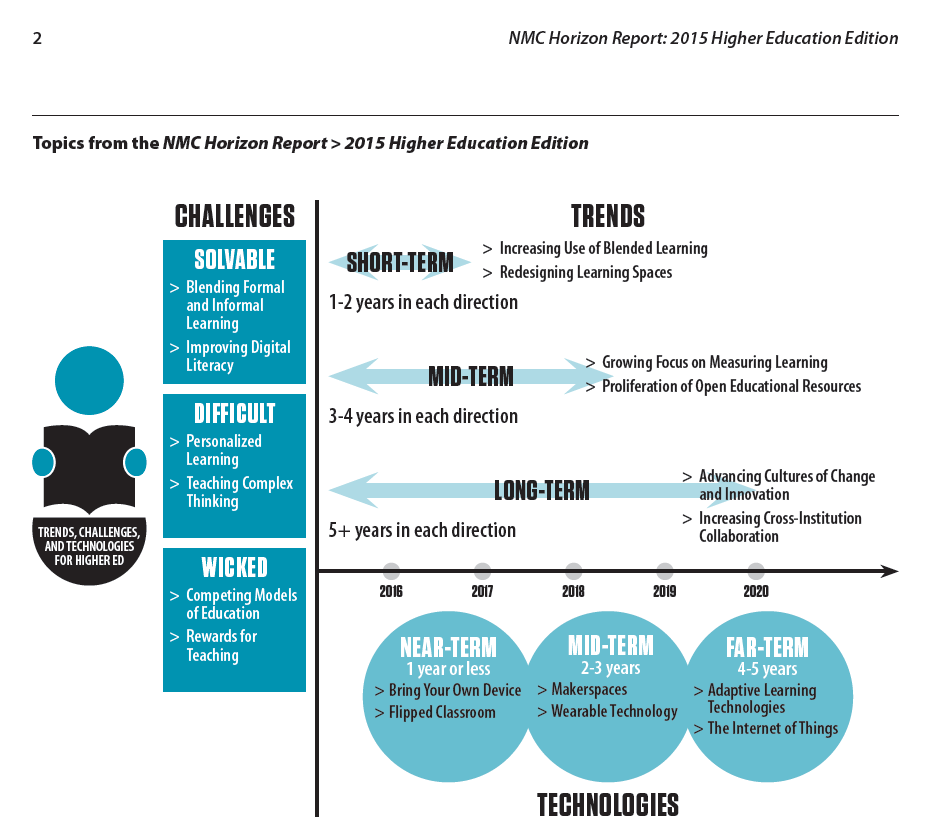
Access to knowledge has changed. Response time during communication has changed. Using research from organizations such as the New Media Consortium, provides institutions of higher education an opportunity to plan for the re-envisioning of collegiate learning. The image to the left was selected from the NMC 2015 Horizon Report to illustrate the challenges, trends, and technologies that are expected to become a mainstay in learning over the next 5 years.
The risks in using the information provided in this report appear minimal at best. The rewards however are immeasurable.
References
Carroll, T.G., & Foster, E. (2010). Who will teach? Experience matters. Washington D.C.: National Commission on Teaching and America’s Future.
Heath, C. H. (2010). Switch: How to change things when change is hard. New York: Broadway Books.
Learning Space Collaboratory. (2012). Retrieved April 10, 2015 from http://www.pkallsc.org/
MacArthur Foundation (2013). Digital media and learning. Retrieved April 22, 2015 from
http://www.macfound.org/media/files/2013_DML_Info_Sheet.pdf
Noweski, C., Scheer, A., Büttner, N., von Thienen, J., Erdmann, J., and Meinel, C.(2012).
Towards a Paradigm Shift in Education Practice: Developing Twenty-First Century Skills with Design Thinking. In: Plattner, Hasso; Meinel, Christoph; Leifer, eds: Design Thinking Research. Measuring Performance in Context. Heidelberg, Dordrecht, London p. 71-94.
Plattner, Hasso; Meinel, Christoph; Leifer, Larry, eds. (2011). Design thinking: understand, improve, apply. Understanding innovation. Berlin; Heidelberg: Springer-Verlag. pp. xiv–xvi. doi:10.1007/978-3-642-13757-0. ISBN 3642137563. OCLC 898322632
 Reimagining Education